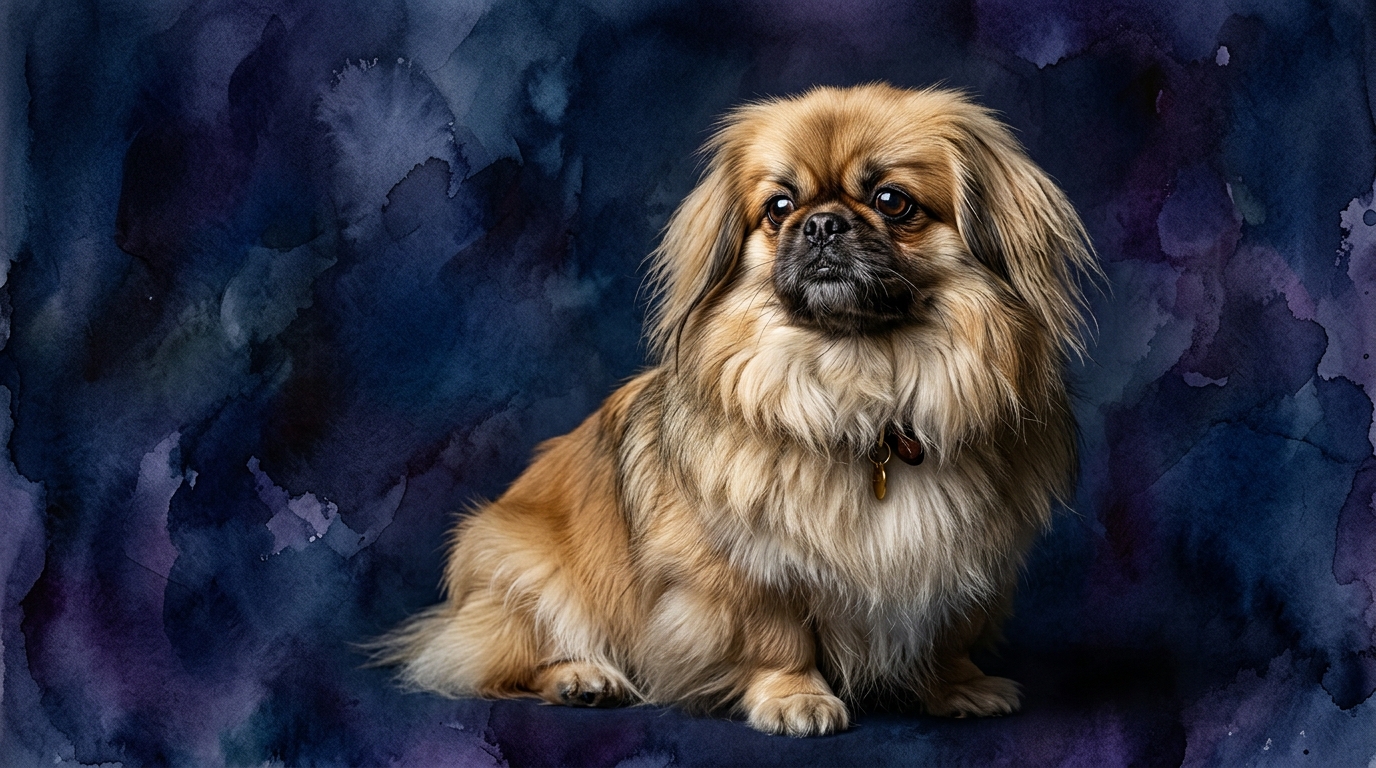
Pekingese at a glance
| IQ Rank / Score | #77 |
|---|---|
| Trainability | ★★☆☆☆ (2/5) |
| Social Intelligence | ★★★★☆ (4/5) |
| Lifespan | 12-16 years |
| Shedding | Low to moderate |
| Exercise Needs | Moderate (30-45 min/day) |
| Origin | China |
Understanding the Imperial Intellect of the Pekingese
For centuries, the Pekingese reigned as a treasured companion within the Forbidden City, a role that shaped an intelligence far removed from the working dog paradigm. Their cognitive strengths developed not around tasks or feats of athleticism, but around understanding human court dynamics, securing their own comfort, and subtly influencing their surroundings. This breed's intelligence is a sophisticated blend of observational wit, selective memory, and an unwavering focus on personal sovereignty, making them masterful navigators of their domestic 'kingdom.' Their minds are sharp, not in the sense of eager obedience, but in their capacity for strategic self-interest and discerning perception of their environment and human companions, always with a regal air.
The Pekingese IQ Breakdown: More Than Meets the Eye
The Cosmic Pet's Pet IQ Lab assesses five key cognitive dimensions to offer a comprehensive profile of the Pekingese's unique mental landscape. Our scoring, on a scale of 1 to 5, reveals a breed whose intelligence is often underestimated due to its independent spirit and historical context. **Problem Solving: 3/5** - Pekingese are adept at solving problems that directly benefit them, such as figuring out how to get to a favorite treat or a cozy nap spot. They won't engage in abstract puzzles for human approval, but for self-gain, they can be surprisingly resourceful and persistent, applying their cleverness to achieve their desired outcomes. **Training Speed: 2/5** - Their placement at #77 out of 138 breeds in Stanley Coren's obedience ranking is not a reflection of a lack of intelligence, but rather a testament to their strong-willed nature and low 'eager-to-please' drive. They learn commands but often choose whether or not to comply based on their own assessment of the situation and motivation, requiring significant positive reinforcement. **Social Intelligence: 4/5** - Highly attuned to the emotions, routines, and nuances of their human companions, Pekingese excel at reading the 'court.' They understand family dynamics and often use this insight to their advantage, knowing exactly who to appeal to for what. They are masters of subtle communication and emotional manipulation within their inner circle. **Instinctive Drive: 3/5** - While not bred for hunting or herding, Pekingese possess a notable watchdog instinct. Their keen senses make them excellent alert systems, quick to bark at perceived intruders or unusual sounds, demonstrating a territorial protective drive focused on their domain and human family. They exhibit a moderate prey drive but it's typically overridden by their desire for comfort. **Memory: 4/5** - Pekingese exhibit excellent memory, retaining information about routines, preferred sleeping areas, hidden treats, and, notably, any perceived injustices or favoritism. They remember who offers the best cuddles and who is most likely to share a snack, using this recall to shape their interactions and ensure their comfort.
A Royal Legacy of Sharp Wits and Selective Obedience
The Pekingese's lineage traces back over two millennia, bred exclusively for the imperial families of China. They were symbols of royalty, often treated with more reverence than human courtiers, sometimes even revered as sacred 'lion dogs.' This profound historical context is crucial to understanding their cognitive makeup. Unlike working breeds developed for specific tasks, Pekingese were bred for dignified companionship, to be cherished and adored. This environment fostered an intelligence that prioritizes comfort, observation, and a profound understanding of social cues over slavish obedience. Their 'stubbornness' isn't a flaw; it's a deeply ingrained aspect of their self-possessed nature, a cognitive trait honed by centuries of being the center of attention and having their desires met. They are not unintelligent; they simply believe *they* are the ones in charge, exhibiting a confident and self-assured mental fortitude.
Regal Social Dexterity and Self-Determined Logic: The Primary Angle
The primary angle of Pekingese intelligence is their 'Regal Social Dexterity and Self-Determined Logic.' This describes their exceptional ability to navigate complex social environments – primarily their human family – to secure their comfort and desires, often with a sophisticated, self-serving logic. They possess an innate understanding of human routines, emotions, and weaknesses, using this knowledge to 'train' their owners rather than being easily trained themselves. A Pekingese will quickly learn which family member is a soft touch for extra treats, or who is most likely to concede to a demand for a lap cuddle. Their cognitive efforts are largely directed towards optimizing their personal well-being and maintaining their dignified status within the household, displaying intelligence through strategic manipulation and observation, not necessarily through eager biddability or overt displays of problem-solving for human gratification. They are subtle masters of their domain.
The Unseen Observer: Pekingese as Palace Guardians
A surprising historical facet of Pekingese cognition reveals they were not just pampered pets but also served as miniature, stealthy 'alert systems' within the ancient Chinese palaces. Despite their small size, their acute senses, particularly hearing, and their naturally territorial instincts made them surprisingly effective at detecting unusual activity or intruders. They would quietly observe their environment, and then sound the alarm with their distinctive bark if anything seemed amiss, often before human guards were aware of the disturbance. This demonstrates a cognitive trait of selective alertness and environmental awareness for protection, a keen observational intelligence that allowed them to be guardians of their sacred spaces, contrasting sharply with their often-perceived lazy or purely ornamental demeanor. They possess a selective focus that belies their plush exterior.
Navigating the Pekingese Mind: Training and Enrichment
Training a Pekingese requires patience, understanding, and a willingness to meet them on their terms. Traditional obedience methods focused on repetition and correction often fail, as these independent thinkers respond poorly to coercion. Instead, success lies in positive reinforcement with high-value rewards – a favorite treat, a coveted toy, or a special cuddle. Make training a game where *they* feel like they're choosing to participate, framing commands as requests that lead to something they desire. Mental enrichment for a Pekingese thrives on activities that engage their observational skills and problem-solving for self-benefit, such as treat-dispensing puzzle toys, short scent games, and consistent, predictable routines that cater to their comfort. Remember, a Pekingese will learn what *they* find worthwhile, so motivation is key to unlocking their intellectual potential. Short, engaging sessions are far more effective than long, demanding ones, respecting their regal attention span.
Beyond the Stereotype: Celebrating Pekingese Cognitive Strengths
The Pekingese challenges the very definition of canine intelligence. While they may not top obedience charts, their cognitive strengths lie in areas often overlooked: their profound social perception, their astute understanding of routines, their memory for what truly matters to them, and their cleverness in achieving personal objectives. To truly appreciate a Pekingese's intelligence is to move beyond conventional metrics and recognize the sophisticated, self-possessed mind of a breed that has always known its own worth. They are not simply 'stubborn'; they are intelligent beings with a distinct will and a unique way of navigating the world, qualities that make them incredibly endearing and fascinating companions for those who understand their imperial legacy and respect their independent spirit.
3 At-Home Tests to Measure Your Pekingese's IQ
These tests are adapted from peer-reviewed ethology research. No equipment is needed beyond items you have at home. Run each test 5–10 times for reliable results.
The Myth: "Pekingese are dumb or untrainable."
✅ Pekingese are highly intelligent but selectively motivated. They understand commands and routines very well but will only comply if they see a personal benefit or if the request aligns with their desires, often outsmarting their owners through their self-determined logic.
Pekingese vs. Similar Breeds
🧠 What's Your Dog's IQ Score?
Our full Pet IQ Lab assessment includes 12+ tests across 5 cognitive dimensions, calibrated for Pekingeses specifically.
Take the Full IQ Test →Frequently Asked Questions
How smart is a Pekingese?
Our Pet IQ Lab framework scores cognition across five dimensions (max 25). The Pekingese totals 11/25 — average for a domestic dog. The full article breaks down each dimension with at-home tests.
Are Pekingeses easy to train?
Pekingeses are independent learners; short, highly-motivating sessions work best. They score 2/5 on Training Speed in our breed profile.
Are Pekingeses good with children and other pets?
Yes — their Social Intelligence rates 4/5 in our Pet IQ Lab framework. With early socialization and supervised play, most Pekingeses integrate well into families with respectful children and other pets.
Do Pekingeses need a lot of mental stimulation?
Pekingeses benefit from 10-15 minutes of focused enrichment a day: food puzzles, short training drills, or novel toys rotated weekly.
How much exercise does a Pekingese need?
Pekingeses do well with 20-40 minutes of daily walks and play plus a few short training moments.
How good is a Pekingese's memory?
Pekingeses score 2/5 on memory. They remember high-value associations well; less-used cues fade without refresher sessions.
What is the typical lifespan of a Pekingese?
Pekingeses commonly live 12-16 years when kept at a healthy weight.
The Pekingese, an ancient breed of profound dignity, challenges our conventional definitions of canine intelligence, proving that a sharp mind can manifest as keen social navigation and self-possessed logic rather than mere obedience. Celebrating their unique cognitive strengths allows us to appreciate these imperial companions for the clever, self-assured individuals they truly are, bringing a royal depth to any home.