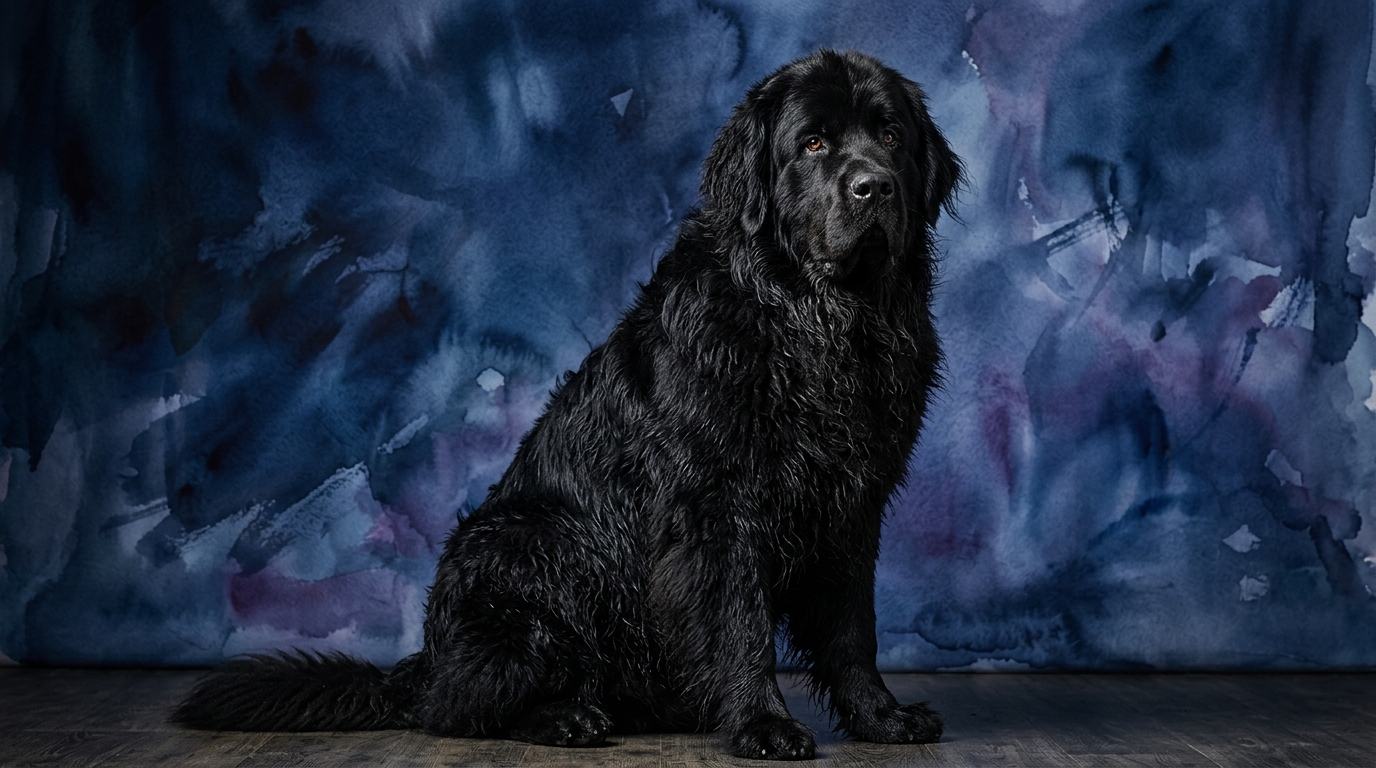
Newfoundland at a glance
| IQ Rank / Score | #34 |
|---|---|
| Trainability | ★★★★☆ (4/5) |
| Social Intelligence | ★★★★★ (5/5) |
| Lifespan | 10-12 years |
| Shedding | Moderate to high |
| Exercise Needs | High (60+ min/day + training) |
| Origin | Canada |
Understanding Newfoundland Intelligence: A Cognitive Compass for the High Seas
Beneath the shaggy, imposing exterior of the Newfoundland lies a profound intellect, meticulously shaped by their original role as working dogs from the rugged coasts of Canada. These gentle giants, standing as a testament to purposeful breeding, consistently demonstrate a remarkable capacity for learning and task execution. Ranked #34 out of 138 breeds by Stanley Coren for obedience and working intelligence, Newfoundlands typically master new commands within 15 to 25 repetitions and obey those commands 85% of the time or better. This places them firmly among breeds capable of consistent performance and understanding complex instructions, signifying a robust cognitive foundation rather than just quick uptake.
Their comprehensive Intelligence Profile illuminates a unique blend of strengths. A solid Problem Solving score of 3/5 suggests they are adept at navigating obstacles and devising solutions in practical scenarios. Their Training Speed, rated at 4/5, indicates they are receptive learners, picking up new concepts with focused instruction. The Newfoundland truly shines in Social Intelligence and Instinctive Drive, both scoring an exceptional 5/5, highlighting their deep empathetic connections and powerful innate purposes. Complementing these is a strong Memory, also at 4/5, ensuring retained knowledge and reliability.
The apex of Newfoundland cognition is undoubtedly their unparalleled water rescue capabilities. This isn't just a learned trick; it's a sophisticated display of water rescue cognition, allowing them to independently assess drowning situations and execute intricate rescue patterns without direct, real-time handler instruction. This autonomous decision-making in critical moments truly sets them apart, transforming them into proactive, life-saving partners in aquatic emergencies.
Their physical adaptations are as remarkable as their mental prowess, perfectly aligning with their rescue legacy. Newfoundlands possess partially webbed feet, providing superior propulsion, and a dense, water-resistant double coat that offers insulation in frigid waters. They execute a unique modified breaststroke when swimming – a powerful and efficient gait not observed in any other dog breed. These specialized traits are not merely incidental; they are fundamental components that underscore their singular aptitude for aquatic work, making their entire physiology a testament to their water rescue purpose.
The Newfoundland's Instinctive Genius: Water Rescue Cognition in Action
Witnessing a Newfoundland respond to a distressed swimmer is to observe canine cognition at its most evolved and empathetic. While many breeds might hesitate or require explicit commands in a chaotic water scenario, the Newfoundland often acts with startling independence and resolve. Their exceptional 5/5 Social Intelligence fuels an immediate, profound understanding of human distress, which, coupled with their equally potent 5/5 Instinctive Drive, compels them to intervene. This isn't merely a conditioned response; it's a deep-seated empathetic drive manifesting as proactive rescue behavior.
The complexity of their water rescue cognition extends far beyond simple retrieval. It encompasses a series of critical judgments: accurately identifying the individual in danger, navigating potentially treacherous currents and waves, approaching the person safely without causing further panic, and then effectively providing stable support to bring them back to shore. They instinctively position themselves to offer maximum assistance, often allowing the person to grasp their thick, buoyant coat or providing a steady presence to guide them. This ability to perform multi-step problem-solving under immense pressure and without explicit direction is a powerful indicator of their sophisticated working intellect.
This innate, life-saving capability seamlessly translates into their well-earned reputation as "nanny dogs." Their acute social intelligence and remarkably gentle demeanor mean they often adopt a watchful, protective role within families, particularly with children. They might subtly intervene to guide a child away from perceived dangers or alert adults to precarious situations with a quiet nudge. This protective instinct, harmonized with their patient and tolerant temperament, beautifully illustrates a deep-seated understanding of vulnerability and a proactive drive to safeguard those they cherish, whether in the water or on land.
Beyond the Waves: Problem Solving and Adaptability in Daily Life
While their aquatic heroism rightfully garners attention, the Newfoundland’s Problem Solving ability (rated 3/5) surfaces in numerous fascinating, albeit less dramatic, everyday contexts. Owners frequently share stories of their Newfies cleverly figuring out how to bypass childproof locks, manipulate complex latches on gates, or ingeniously retrieve a beloved toy from seemingly impossible nooks. This consistent, moderate problem-solving capacity suggests they are not just reactive but capable of analytical thought, evaluating a situation, and devising sequential steps to achieve a desired outcome, even if they aren't constantly inventing groundbreaking solutions.
Their Training Speed (4/5) signifies a breed that is highly receptive to learning new commands and routines. While perhaps not as instantaneously responsive as some high-drive herding breeds, Newfoundlands absorb information efficiently with consistent, positive reinforcement and clear communication. This aptitude, synergized with their strong 4/5 Memory, means that once a command or behavior is learned, it is deeply ingrained and reliably recalled over extended periods. This impressive retention is crucial for a working breed whose tasks often require unwavering consistency and dependable execution, whether navigating complex trails or performing a multi-stage rescue.
The cognitive strengths of the Newfoundland are inextricably linked to their historical origins as indispensable working dogs in Canadian fishing communities. Their roles extended far beyond simple companionship; they were vital members of the crew, tasked with hauling heavy fishing nets, retrieving equipment lost overboard, and, most critically, rescuing fishermen from the treacherous, frigid waters of the North Atlantic. Their intelligence profile, therefore, is not accidental but a deliberate refinement over centuries, emphasizing independence, resilience, profound empathy, and an unwavering capacity for decisive action in high-stakes environments. This heritage underscores every facet of their remarkable intellectual makeup.
3 At-Home Tests to Measure Your Newfoundland's IQ
These tests are adapted from peer-reviewed ethology research. No equipment is needed beyond items you have at home. Run each test 5–10 times for reliable results.
The Myth: "Newfoundlands are too massive and slow to be truly intelligent working dogs"
✅ While their physical movements can appear ponderous on land, their cognitive processes, particularly in water, are anything but slow. Their strength and deliberate nature are assets, enabling sustained effort in rescue situations rather than hindering quick decision-making. Their powerful instincts and problem-solving capabilities reveal a highly effective working intelligence, perfectly tailored to their life-saving roles.
Newfoundland vs. Similar Breeds
🧠 What's Your Dog's IQ Score?
Our full Pet IQ Lab assessment includes 12+ tests across 5 cognitive dimensions, calibrated for Newfoundlands specifically.
Take the Full IQ Test →Frequently Asked Questions
How smart is a Newfoundland?
Our Pet IQ Lab framework scores cognition across five dimensions (max 25). The Newfoundland totals 21/25 — very high for a domestic dog. The full article breaks down each dimension with at-home tests.
Are Newfoundlands easy to train?
Newfoundlands are generally easy to train when you use consistent, reward-based sessions. They score 4/5 on Training Speed in our breed profile.
Are Newfoundlands good with children and other pets?
Yes — their Social Intelligence rates 5/5 in our Pet IQ Lab framework. With early socialization and supervised play, most Newfoundlands integrate well into families with respectful children and other pets.
Do Newfoundlands need a lot of mental stimulation?
Absolutely. With Problem Solving 3/5 and Instinctive Drive 5/5, Newfoundlands need daily mental work — puzzle feeders, scent games, training sessions, or nose-work — to avoid boredom.
How much exercise does a Newfoundland need?
Newfoundlands need active engagement. Plan for 45-60 minutes of exercise and training per day, plus mental stimulation.
How good is a Newfoundland's memory?
Newfoundlands score 4/5 on memory. They remember routines, hiding spots, and learned cues for months, sometimes years.
What is the typical lifespan of a Newfoundland?
Typical lifespan is 10-12 years for a giant dog like the Newfoundland.
The Newfoundland stands as a testament to specialized canine cognition, where immense strength meets an equally profound capacity for empathy and independent problem-solving. Far from being merely large and placid, their minds are finely tuned instruments of rescue and companionship, proving that true intelligence is often found in purpose-driven action.