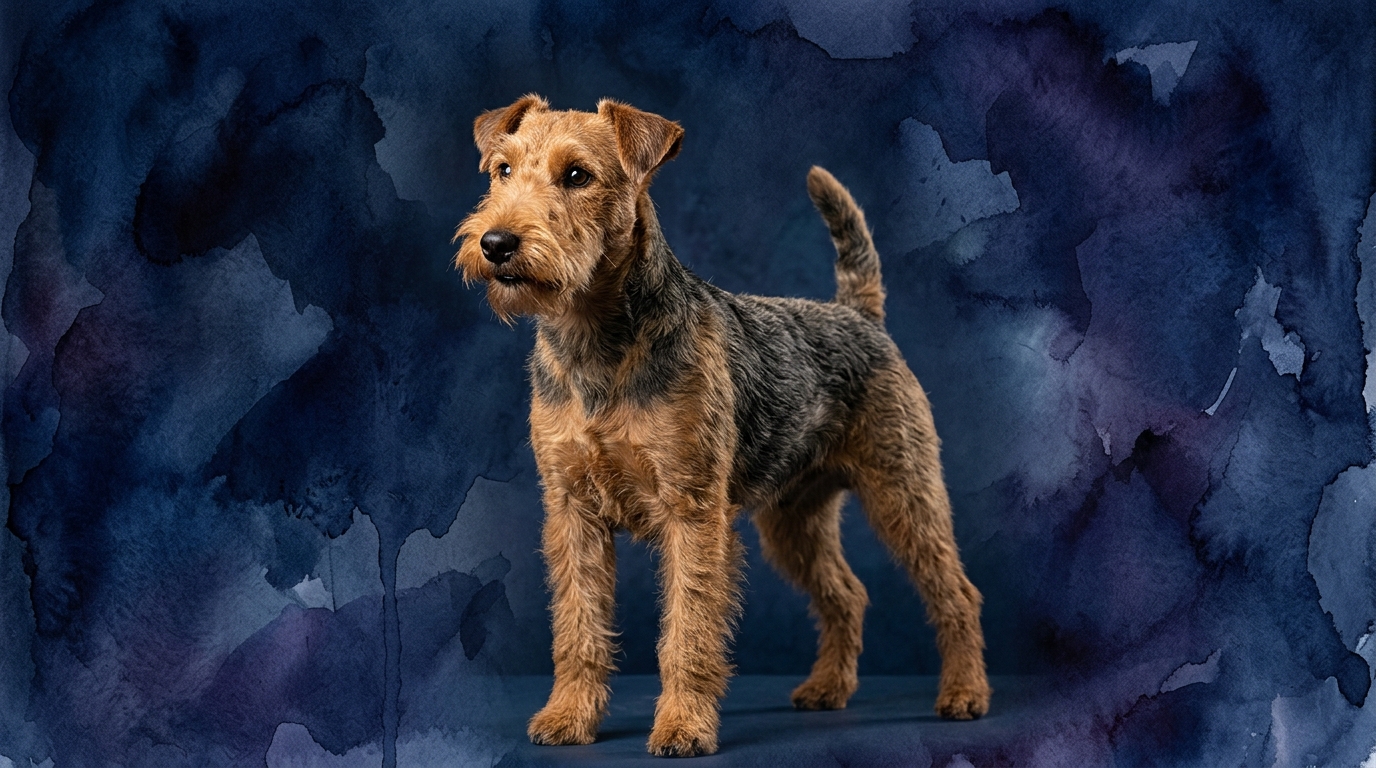
Welsh Terrier at a glance
| IQ Rank / Score | 12/25 |
|---|---|
| Trainability | ★★★☆☆ (3/5) |
| Social Intelligence | ★★★☆☆ (3/5) |
| Lifespan | 12-16 years |
| Shedding | Low to moderate |
| Exercise Needs | Moderate (30-45 min/day) |
| Origin | Wales |
The Cosmic Pet's Pet IQ Lab: Welsh Terrier Intelligence Profile
Welcome to The Cosmic Pet's Pet IQ Lab, where we delve into the intricate minds of our canine companions. Our comprehensive profile for the Welsh Terrier reveals a breed whose cognitive strengths are deeply rooted in its heritage as a tenacious working dog. Their intelligence isn't about rote obedience but about shrewd decision-making, remarkable adaptability, and a singular focus when pursuing a goal.
The Welsh Terrier's cognitive landscape is defined by its ability to assess situations, formulate strategies independently, and persist until a solution is found. This makes them highly engaging companions for those who appreciate a thinking dog, but it also means training must be approached with creativity, consistency, and a deep understanding of their terrier spirit. They thrive on challenges that engage both their keen minds and their powerful instincts.
Primary Angle: The Adaptable, Tenacious Strategist
The Welsh Terrier's primary cognitive angle centers on its identity as an adaptable, tenacious strategist. Unlike many breeds bred for close human collaboration or specific, repetitive tasks, the Welsh Terrier was developed to work independently, often out of sight, to locate and dispatch quarry in diverse and challenging environments. This required not just courage and physical prowess, but significant cognitive flexibility and independent decision-making.
Their intelligence is characterized by an innate ability to rapidly analyze complex situations, devise original solutions to obstacles, and exhibit remarkable persistence, even when faced with setbacks. This translates into a dog that isn't content to simply follow orders blindly but actively processes information, often forming their own 'plan of action.' This independent strategic thinking, coupled with an unshakeable determination, is what truly sets the Welsh Terrier apart cognitively.
Historical & Cognitive Insights: The Earth Dog's Ingenuity
Originating from Wales, the Welsh Terrier's history is steeped in the practical demands of working alongside farmers and hunters. Bred for 'earth work,' they were tasked with finding and flushing out vermin such as foxes, badgers, and otters from their subterranean lairs. This was not a job for a dog awaiting constant instruction; it demanded a canine capable of navigating complex underground tunnel systems, assessing risks, and making split-second decisions entirely on its own.
A surprising historical insight into their cognition is their exceptional adaptability across different types of quarry and terrain. While many terriers were specialized, the Welsh Terrier was often a 'jack-of-all-trades,' capable of working above ground in open fields, through dense brush, and deep underground. This broad utility speaks to an incredible cognitive versatility—the ability to apply problem-solving skills and instinctive drives effectively across varied and unpredictable scenarios, rather than being limited to a single hunting pattern. This required advanced spatial reasoning, memory for complex routes, and flexible hunting strategies, far beyond simple prey drive.
Welsh Terrier IQ Scores Explained
Understanding the Welsh Terrier's intelligence requires appreciating the unique ways their minds operate, shaped by centuries of selective breeding for independence and tenacity. Here’s a breakdown of their scores on our 1-5 scale:
**Problem-Solving: 4/5** Welsh Terriers excel at independent problem-solving. They are resourceful and creative in overcoming obstacles, whether it's figuring out how to open a gate, retrieve a hidden toy, or outsmart a critter. Their historical role demanded this ingenuity, and it remains a hallmark of their cognitive profile. They won't easily give up on a challenge.
**Training Speed: 3/5** While highly intelligent and quick to grasp new concepts, their independent nature means Welsh Terriers may not always be 'fast' in their immediate compliance. They learn rapidly but often choose to execute commands on their own terms or after a moment of consideration, especially if they perceive a higher-value alternative. Consistency and positive reinforcement are crucial to motivate them.
**Social Intelligence: 3/5** Welsh Terriers are capable of strong bonds with their families, often showing a charming and affectionate side. However, their social intelligence is selective; they are not typically 'people-pleasers' in the way many retrieve-oriented breeds are. They can be assertive with other dogs and often reserve their deepest affection for their immediate human companions, assessing strangers with a discerning eye.
**Instinctive Drive: 5/5** This is where the Welsh Terrier truly shines. Their prey drive and inherent tenacity are exceptionally strong. They possess an unyielding determination to pursue scents, dig, and investigate, a direct legacy of their working heritage. This powerful instinct can be both a challenge and a strength, making them excellent in scent work or earth dog trials when properly channeled.
**Memory: 4/5** Welsh Terriers possess excellent memories, particularly for routines, command associations, and the locations of interesting things (like squirrel routes or buried treasures). Once they learn a command or a spatial layout, they tend to retain it well. This strong memory contributes to their problem-solving abilities and makes consistent training effective in the long run.
Harnessing the Welsh Terrier's Intelligence: Training Strategies
Training a Welsh Terrier is a rewarding experience that requires understanding their unique cognitive makeup. Their independence isn't 'stubbornness' but an expression of their strategic mind. Engaging their intellect rather than trying to suppress it is key to success. Utilize positive reinforcement, making training sessions fun, varied, and short to hold their attention.
Incorporate their natural drives into training. Scent work, agility, and earth dog trials are excellent outlets for their instinctive intelligence and physical energy. Puzzle toys and interactive games that require problem-solving will keep their minds sharp and prevent boredom, which can lead to destructive behaviors. Consistency is paramount; clear rules and boundaries, established early and maintained diligently, will help guide their independent spirit towards desired behaviors.
3 At-Home Tests to Measure Your Welsh Terrier's IQ
These tests are adapted from peer-reviewed ethology research. No equipment is needed beyond items you have at home. Run each test 5–10 times for reliable results.
The Myth: "Welsh Terriers are stubborn and difficult to train."
✅ Welsh Terriers are highly intelligent and capable of learning complex commands and tasks quickly. Their independence means they respond best to consistent, positive, and engaging training methods that make them feel like a partner, not just a subordinate. They thrive on mental stimulation and purpose-driven activities.
Welsh Terrier vs. Similar Breeds
🧠 What's Your Dog's IQ Score?
Our full Pet IQ Lab assessment includes 12+ tests across 5 cognitive dimensions, calibrated for Welsh Terriers specifically.
Take the Full IQ Test →Frequently Asked Questions
How smart is a Welsh Terrier?
Our Pet IQ Lab framework scores cognition across five dimensions (max 25). The Welsh Terrier totals 12/25 — average for a domestic dog. The full article breaks down each dimension with at-home tests.
Are Welsh Terriers easy to train?
Welsh Terriers can learn most cues, but expect to repeat lessons and keep sessions short. They score 3/5 on Training Speed in our breed profile.
Are Welsh Terriers good with children and other pets?
Welsh Terriers can live well with families when socialized early. Their Social Intelligence scores 3/5, so supervise interactions with small children and introduce new pets gradually.
Do Welsh Terriers need a lot of mental stimulation?
Welsh Terriers benefit from 10-15 minutes of focused enrichment a day: food puzzles, short training drills, or novel toys rotated weekly.
How much exercise does a Welsh Terrier need?
Welsh Terriers do well with 20-40 minutes of daily walks and play plus a few short training moments.
How good is a Welsh Terrier's memory?
Welsh Terriers score 2/5 on memory. They remember high-value associations well; less-used cues fade without refresher sessions.
What is the typical lifespan of a Welsh Terrier?
Welsh Terriers commonly live 12-16 years when kept at a healthy weight.
The Welsh Terrier stands as a testament to intelligent design, a breed whose cognitive strengths are as sharp and distinctive as their charming appearance. Understanding and embracing their independent, tenacious, and strategic mind unlocks a deeply rewarding partnership with this remarkable canine companion.