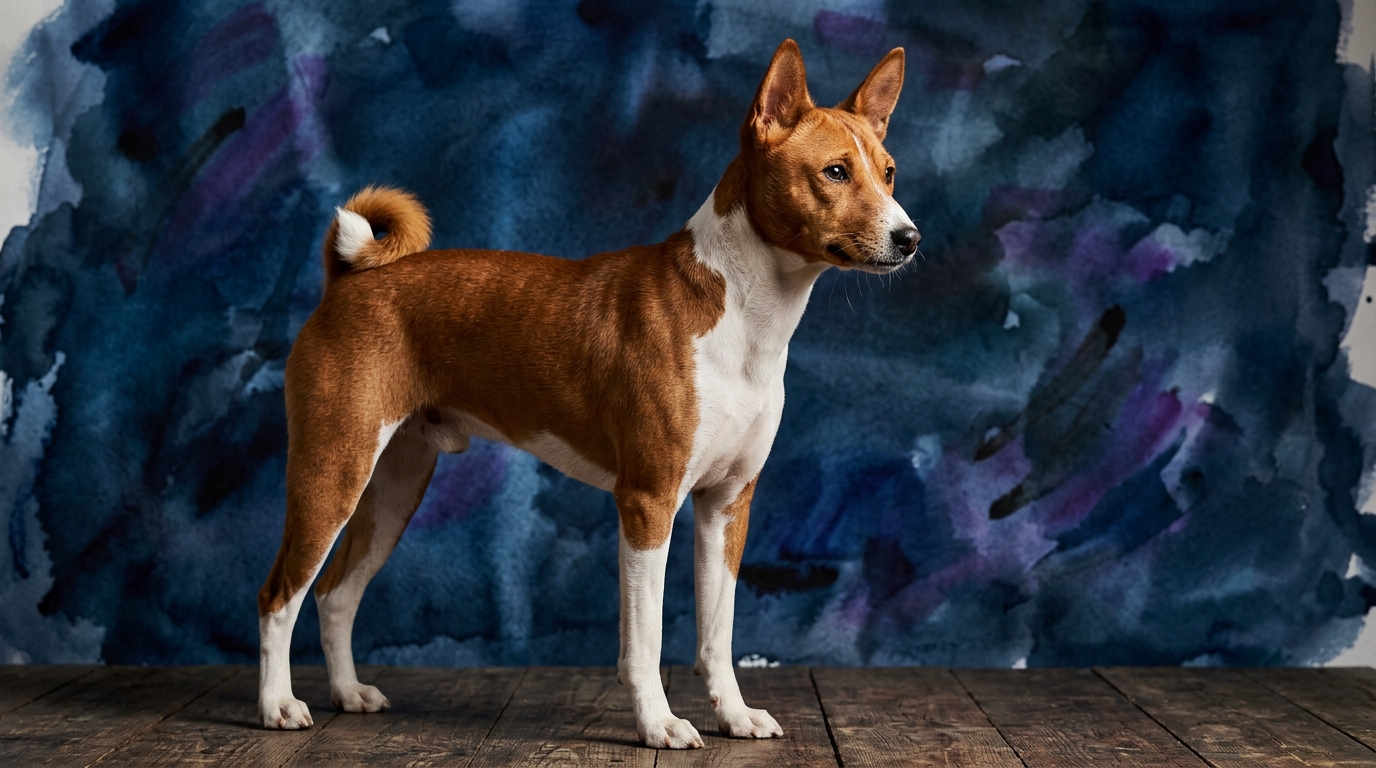
Basenji at a glance
| IQ Rank / Score | #78 |
|---|---|
| Trainability | ★☆☆☆☆ (1/5) |
| Social Intelligence | ★★★☆☆ (3/5) |
| Lifespan | 12-16 years |
| Shedding | Low to moderate |
| Exercise Needs | High (60+ min/day + training) |
| Origin | Central Africa (Congo) |
The Basenji's Enigmatic Mind: A Glimpse into Wild Cognition
The Basenji, sometimes called the 'African barkless dog,' hails from the dense jungles of the Congo, where for centuries it hunted alongside humans. This long history has shaped a distinct intelligence, one less focused on rote obedience and more on independent thought and self-reliance. Unlike many modern breeds, the Basenji retains wild-type cognition, approaching novel problems through trial-and-error learning, much like their ancestral wolves. Their problem-solving abilities are a testament to their survival instincts.
Beyond their unique mental blueprint, Basenjis possess several biological peculiarities that set them apart in the canine world. Basenjis cannot bark. They produce a unique yodel-like sound called a 'baroo,' a truly distinctive vocalization. They also groom themselves meticulously like cats, a fastidious habit rarely seen in other dog breeds. Adding to their distinctiveness, Basenjis have only one estrus cycle per year — unlike all other dogs, which typically have two. These traits underscore their ancient origins and remarkable divergence from mainstream dogdom.
Decoding the Basenji Intelligence Profile
To truly understand a Basenji's mind, we look beyond conventional measures of obedience. Their intelligence profile reveals a fascinating blend of strengths that speak to their ancestral environment: Problem Solving: 5/5, Training Speed: 1/5, Social Intelligence: 3/5, Instinctive Drive: 5/5, and Memory: 4/5. These scores paint a picture of a dog that is exceptionally resourceful and driven by innate instincts, rather than one seeking constant human direction.
The 5/5 in Problem Solving highlights their ability to assess situations and devise solutions independently, often through clever experimentation. This isn't about learning a trick quickly, but figuring out how to open a gate or outsmart a squirrel. Their 1/5 Training Speed, as ranked by Stanley Coren, doesn't signify a lack of intellect, but rather a profound independence and a lower drive to please humans through repetitive tasks. Instead, their 5/5 Instinctive Drive fuels behaviors like hunting, exploring, and self-preservation, making them highly attuned to their environment. Coupled with a strong 4/5 Memory, Basenjis remember complex spatial layouts and learned solutions to past challenges, even if they're not eager to perform a 'sit' on command.
An Ancestral Blueprint: How Basenjis Tackle the World
The Basenji's primary intelligence angle — feral problem-solving — means they approach challenges with an ancestral mindset. Instead of waiting for instruction, they observe, experiment, and adapt. This trial-and-error learning style, mirrored in wild canids, makes them adept at navigating complex environments, finding hidden resources, or escaping confinement. If there's a way around an obstacle, a Basenji will methodically test options until they find it, demonstrating persistence and ingenuity.
This self-reliant approach contrasts sharply with many breeds bred for close collaboration. A Basenji’s brain is wired for autonomy, making them excellent at independent tasks like tracking or vigilance. Their memory serves them well in these endeavors, allowing them to recall successful strategies and intricate pathways. Living with a Basenji means recognizing and respecting this profound self-determination, understanding that their cognitive strengths lie in their ability to think for themselves.
Thriving with a Basenji: Cultivating Independent Intellect
Living with a Basenji requires patience and a deep appreciation for their unique cognitive makeup. Traditional obedience training, which heavily influenced Coren's rankings, often clashes with their independent nature. Instead of expecting immediate, flawless compliance, focus on positive reinforcement methods that engage their problem-solving skills and instinctive drives. Puzzle toys, scent work, and agility courses can be excellent ways to challenge their minds, allowing them to figure things out on their own terms.
Secure environments are crucial for these resourceful dogs, as their drive to explore and solve problems can lead them to ingenious escapes. Understanding their low training speed means adjusting expectations: a Basenji might learn a command, but whether they choose to perform it consistently is often up to them. Embrace their independent spirit, channel their problem-solving acumen into constructive activities, and you'll find a captivating and intellectually stimulating companion.
3 At-Home Tests to Measure Your Basenji's IQ
These tests are adapted from peer-reviewed ethology research. No equipment is needed beyond items you have at home. Run each test 5–10 times for reliable results.
The Myth: "The Basenji's low Coren rank proves it's one of the dumbest breeds."
✅ While Basenjis rank #78 out of 138 breeds in Coren's system, this reflects their profound independence and low motivation for repetitive obedience, not a lack of cognitive ability. Basenjis excel in independent problem-solving, possessing a deep, wild-type intelligence that allows them to figure out complex situations through trial-and-error, a skill not prioritized in Coren's specific tests. Their 'unwillingness' to comply often stems from their ancestral self-reliance, rather than an inability to comprehend.
Basenji vs. Similar Breeds
🧠 What's Your Dog's IQ Score?
Our full Pet IQ Lab assessment includes 12+ tests across 5 cognitive dimensions, calibrated for Basenjis specifically.
Take the Full IQ Test →Frequently Asked Questions
How smart is a Basenji?
Our Pet IQ Lab framework scores cognition across five dimensions (max 25). The Basenji totals 18/25 — high for a domestic dog. The full article breaks down each dimension with at-home tests.
Are Basenjis easy to train?
Basenjis are independent learners; short, highly-motivating sessions work best. They score 1/5 on Training Speed in our breed profile.
Are Basenjis good with children and other pets?
Basenjis can live well with families when socialized early. Their Social Intelligence scores 3/5, so supervise interactions with small children and introduce new pets gradually.
Do Basenjis need a lot of mental stimulation?
Absolutely. With Problem Solving 5/5 and Instinctive Drive 5/5, Basenjis need daily mental work — puzzle feeders, scent games, training sessions, or nose-work — to avoid boredom.
How much exercise does a Basenji need?
Basenjis need active engagement. Plan for 45-60 minutes of exercise and training per day, plus mental stimulation.
How good is a Basenji's memory?
Basenjis score 4/5 on memory. They remember routines, hiding spots, and learned cues for months, sometimes years.
What is the typical lifespan of a Basenji?
Basenjis commonly live 12-16 years when kept at a healthy weight.
The Basenji challenges our conventional notions of canine intelligence, offering a profound connection to the wild heart of the dog world. Embrace their ancient instincts, independent spirit, and unique problem-solving abilities, and you'll discover a truly remarkable and intellectually stimulating companion.