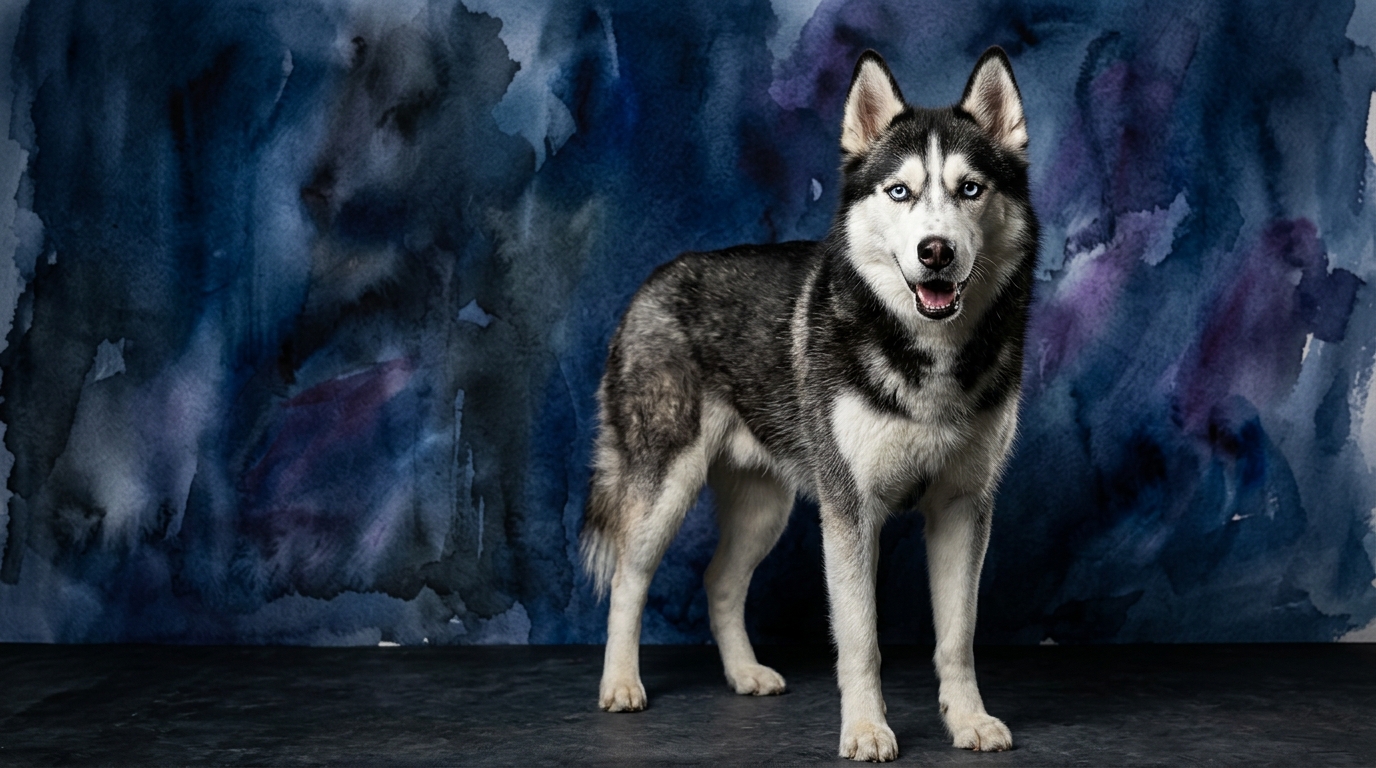
Siberian Husky at a glance
| IQ Rank / Score | #45 |
|---|---|
| Trainability | ★★☆☆☆ (2/5) |
| Social Intelligence | ★★★☆☆ (3/5) |
| Lifespan | 11-14 years |
| Shedding | Low to moderate |
| Exercise Needs | High (60+ min/day + training) |
| Origin | Siberia (Russia) |
The Siberian Husky Brain: A Deep Dive into Autonomous Intelligence
Belonging to the Working Group, Siberian Huskies are often perceived through the lens of traditional obedience, yet their cognitive blueprint tells a different story. When Stanley Coren ranked dog breeds by obedience, the Siberian Husky landed at #45 out of 138 breeds, a placement that might initially suggest a lack of intellect. However, this ranking largely reflects their willingness to consistently follow human commands, rather than their innate problem-solving capabilities or the depth of their independent thought processes.
Their primary intelligence angle lies in what we call 'autonomous intelligence' – the capacity to solve problems and make decisions without constant human input. Unlike breeds selectively bred for tight collaboration and immediate obedience, Huskies were engineered to operate effectively at a distance from their human companions, making critical choices independently in challenging environments. This ingrained self-reliance is not a deficit in their brainpower, but rather a specialized form of intelligence that manifests differently from a German Shepherd's or a Labrador's.
This drive for independence directly influences their cognitive profile: exceptionally high in Problem Solving (4/5) and Instinctive Drive (5/5), moderate in Social Intelligence (3/5) but notably lower in Training Speed (2/5). These scores highlight a dog built to navigate complex situations and trust its own judgment, often prioritizing its own assessment of a situation over a human's directive. Understanding this fundamental difference is key to appreciating the Husky's true intellectual prowess.
Built for Endurance, Engineered for Thought: The Chukchi Legacy
To truly understand the Siberian Husky's unique cognitive makeup, we must look to their ancestral roots with the Chukchi people of Siberia. These indigenous people meticulously bred Huskies for an extraordinary purpose: to cover 100+ miles per day on minimal food, often across vast, frozen landscapes. Their metabolism and endurance cognition are unmatched by any other breed, a testament to generations of selective breeding for survival in extreme conditions.
This demanding role required more than just physical stamina; it demanded incredible mental resilience and decision-making skills. A Husky pulling a sled train had to assess snow conditions, sense potential dangers, and navigate treacherous terrain independently, often miles ahead of their human driver who might be riding in the sled. They needed to make split-second judgments about the safest path, conserve energy efficiently, and remember complex routes, all without explicit commands.
Their profound instinctive drive (5/5) is a direct inheritance from this history, manifesting as a strong urge to run, explore, and follow scents, which were once crucial for navigating and finding resources. This isn't stubbornness; it's a deep-seated programming for self-preservation and efficiency. Their problem-solving acumen (4/5) also developed from needing to figure out how to overcome obstacles in their path, whether it was finding a way around an ice flow or strategizing the best approach to a difficult climb, all for the collective success of the team.
Decoding the Husky Intelligence Profile: More Than Just Obedience
Let's unpack the specific facets of the Siberian Husky's intelligence profile to see how their autonomous nature translates into measurable cognitive strengths and challenges. Their Problem Solving score of 4/5 reflects an exceptional capacity to navigate complex situations, figure out puzzles, and adapt to new challenges, often in creative and unexpected ways. This means they are brilliant at 'escaping' from yards or opening latches, not because they are mischievous, but because they are constantly evaluating their environment for opportunities.
Conversely, their Training Speed of 2/5 often leads to misconceptions. This isn't a measure of their ability to learn, but rather their willingness to perform a command repeatedly and consistently on cue, especially if they don't see the immediate value. Huskies learn quickly – their Memory is a strong 4/5 – but they are selective about what they choose to act upon, prioritizing their own perceived needs or instincts. They remember commands perfectly, they just might choose to 'negotiate' their execution.
Their Social Intelligence (3/5) indicates they are capable of forming strong bonds and understanding social cues, but it's balanced by their inherent independence; they thrive with companionship but aren't typically as 'people-pleasing' as some other breeds. The standout Instinctive Drive (5/5) means their natural urges for exploring, running, and hunting are incredibly powerful, requiring careful management and appropriate outlets. These drives are the engine of their ancestral brilliance, but can be challenging in a domestic setting if not properly channeled.
Is Your Husky a Canine Genius? Try These At-Home IQ Tests
Curious to see your Siberian Husky's autonomous intelligence in action? These simple, at-home tests are designed to highlight their problem-solving skills, spatial reasoning, and adaptability, offering a glimpse into the unique workings of their mind. Remember, the goal isn't just a 'score,' but an opportunity to understand your dog's cognitive style.
3 At-Home Tests to Measure Your Siberian Husky's IQ
These tests are adapted from peer-reviewed ethology research. No equipment is needed beyond items you have at home. Run each test 5–10 times for reliable results.
The Myth: "Siberian Huskies are dumb because they won't obey basic commands reliably."
✅ The truth is, Huskies are incredibly intelligent, but their intelligence is structured for autonomous problem-solving and survival, not strict human command following. They learn quickly and have excellent memory, but their strong will and independent decision-making mean they often weigh the value of a command against their own instincts or perceived benefits. Their 'disobedience' is often a display of independent thought, not a lack of cognitive capacity.
Siberian Husky vs. Similar Breeds
🧠 What's Your Dog's IQ Score?
Our full Pet IQ Lab assessment includes 12+ tests across 5 cognitive dimensions, calibrated for Siberian Huskys specifically.
Take the Full IQ Test →Frequently Asked Questions
How smart is a Siberian Husky?
Our Pet IQ Lab framework scores cognition across five dimensions (max 25). The Siberian Husky totals 18/25 — high for a domestic dog. The full article breaks down each dimension with at-home tests.
Are Siberian Huskys easy to train?
Siberian Huskys are independent learners; short, highly-motivating sessions work best. They score 2/5 on Training Speed in our breed profile.
Are Siberian Huskys good with children and other pets?
Siberian Huskys can live well with families when socialized early. Their Social Intelligence scores 3/5, so supervise interactions with small children and introduce new pets gradually.
Do Siberian Huskys need a lot of mental stimulation?
Absolutely. With Problem Solving 4/5 and Instinctive Drive 5/5, Siberian Huskys need daily mental work — puzzle feeders, scent games, training sessions, or nose-work — to avoid boredom.
How much exercise does a Siberian Husky need?
Siberian Huskys need active engagement. Plan for 45-60 minutes of exercise and training per day, plus mental stimulation.
How good is a Siberian Husky's memory?
Siberian Huskys score 4/5 on memory. They remember routines, hiding spots, and learned cues for months, sometimes years.
What is the typical lifespan of a Siberian Husky?
Expect a lifespan of 11-14 years for a healthy Siberian Husky.
The Siberian Husky's intelligence is a magnificent testament to specialized breeding for survival and self-reliance, not a measure of how well they follow human directives. By appreciating their autonomous minds, owners can unlock a deeper bond and truly celebrate the independent spirit of these extraordinary canine thinkers.