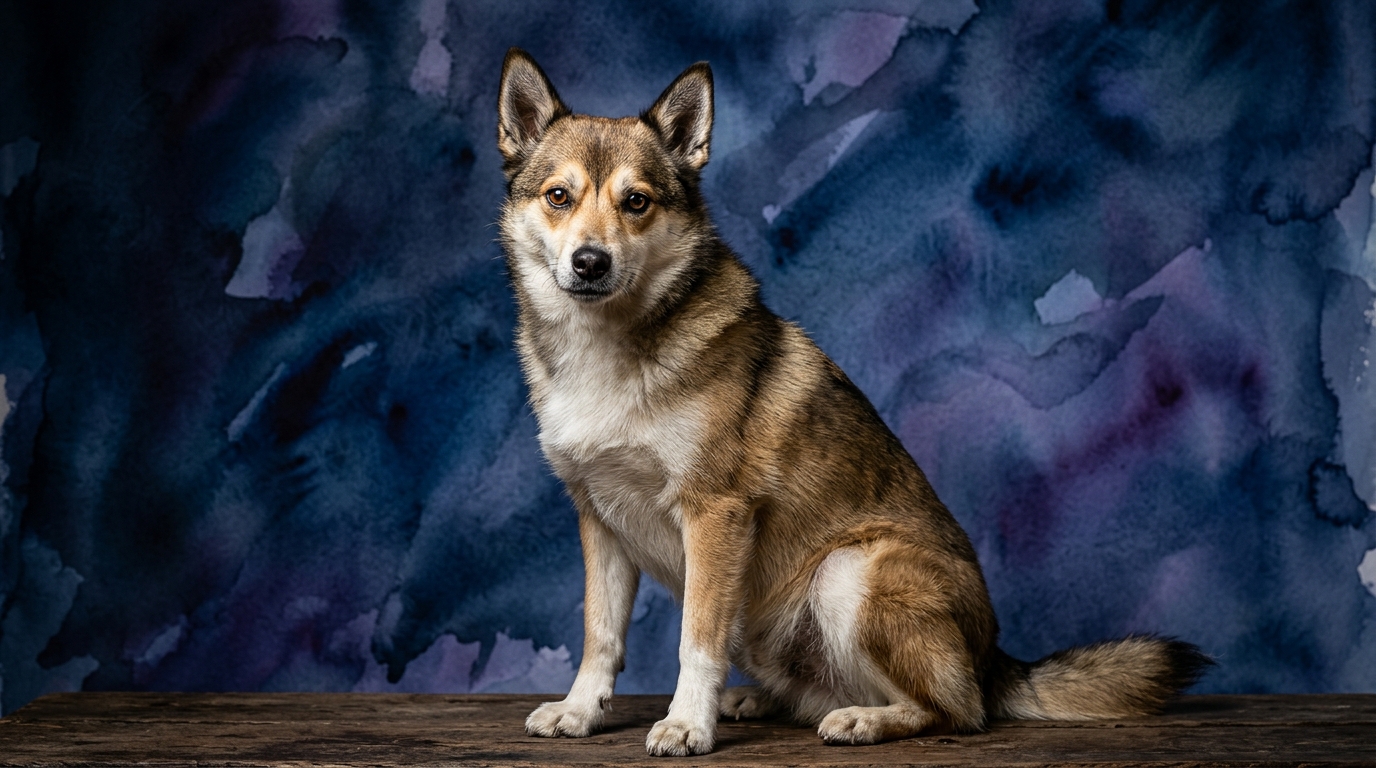
Norwegian Lundehund at a glance
| IQ Rank / Score | 12/25 |
|---|---|
| Trainability | ★★★☆☆ (3/5) |
| Social Intelligence | ★★★☆☆ (3/5) |
| Lifespan | 12-16 years |
| Shedding | Low to moderate |
| Exercise Needs | Moderate (30-45 min/day) |
| Origin | Norway |
The Marvel of the Multi-Toed Hunter
Originating from the remote islands off Norway's coast, the Norwegian Lundehund is one of the world's most unique dog breeds, not just for its physical attributes but for the profound cognitive demands of its historical role. This small, agile dog was meticulously bred to hunt puffins, navigating narrow, slippery cliffs and deep rock crevices where human hands or larger dogs couldn't reach. Their six toes, highly flexible spine, and ability to close their ear canals are famous physical traits, but these adaptations are inextricably linked to a specific set of cognitive skills that allowed them to thrive in such an extreme niche. Understanding the Lundehund's intelligence requires looking beyond conventional metrics, appreciating the ingenuity required for independent, solitary hunting in a challenging, ever-changing landscape.
The breed's history is a story of specialization. Unlike dogs bred for herding or retrieving, the Lundehund operated largely independently, making strategic decisions on how to enter a burrow, flush out a bird, and retrieve it without damaging the delicate feathers or meat. This task demanded an exceptional degree of spatial awareness, problem-solving under pressure, and a cautious yet persistent drive. Their intelligence isn't about rote obedience or social cooperation with humans in complex tasks, but rather about self-reliance and environmental mastery. The Lundehund's mind is a finely tuned instrument for navigating the intricate puzzles presented by nature, demonstrating a unique blend of instinct and adaptive learning that has ensured their survival for centuries.
The Lundehund's Cognitive Cornerstone: Adaptive Problem-Solving
The primary angle for understanding the Norwegian Lundehund's intelligence is its highly developed capacity for **Adaptive Problem-Solving in Extreme Environments**. This isn't just about general dog smarts; it's about a specific, inherited predisposition and learned ability to assess, strategize, and execute solutions in physically demanding and dynamically changing situations. Imagine a dog needing to determine the best entry point into a complex rock crevice, navigating unseen tunnels, cornering agile prey, and then extracting itself and its catch—all independently, without human direction or assistance. This requires not only superior spatial reasoning but also an inherent drive to persist and adapt strategies when initial attempts fail.
This unique cognitive trait manifests in their daily lives. Lundehunds are often observed meticulously exploring new spaces, using their flexible bodies to fit into tight spots, and persistent in trying to reach desired objects. Their intelligence is less about rapid obedience to complex commands and more about self-directed ingenuity. Owners often report their Lundehunds are master escape artists or incredibly resourceful in reaching forbidden areas, showcasing this same problem-solving prowess. This adaptive intelligence makes them fascinating companions, but also requires owners to provide ample mental stimulation and secure environments to channel their innate drive constructively.
Unpacking the Lundehund IQ: A Score Breakdown
At The Cosmic Pet's Pet IQ Lab, we assess canine intelligence across five key dimensions. The Norwegian Lundehund's scores reflect their specialized history and unique cognitive strengths:
**Problem-Solving (4/5):** The Lundehund excels here, a direct consequence of their historical role requiring independent thought and strategy to navigate complex environments and outsmart prey. They are highly resourceful and persistent when faced with obstacles or puzzles.
**Training Speed (3/5):** While capable of learning, Lundehunds aren't typically known for rapid obedience. Their independent nature means they often prioritize their own agenda over human commands, requiring patient, positive reinforcement and understanding of their self-reliant character. They learn best when training feels like a partnership or a game they choose to engage in.
**Social Intelligence (3/5):** Lundehunds form strong bonds with their human families and can be affectionate. However, their independent hunting background means they aren't instinctively driven to work in large groups or seek constant social interaction with unfamiliar dogs or people. They can be reserved with strangers and prefer the company of their chosen few. This score reflects a balanced social acumen, not overly pack-oriented but deeply loyal to their core family.
**Instinctive Drive (4/5):** This breed possesses a powerful instinctive drive, encompassing their strong prey drive, digging tendencies, and desire to climb and explore. These instincts are deeply ingrained from generations of specialized puffin hunting and are a fundamental aspect of their cognitive makeup, requiring appropriate outlets in a modern home.
**Memory (3/5):** Lundehunds have a solid memory for routines, learned commands, and spatial layouts, crucial for navigating complex burrows and cliff paths. While not exceptional in the way some breeds excel at remembering vast numbers of objects, their practical memory is well-suited to their needs, allowing them to recall successful strategies and safe paths.
A Startling Scientific Survival Story
One of the most surprising scientific and historical facts about the Norwegian Lundehund's cognition is deeply intertwined with its harrowing journey from near extinction. The modern Lundehund population descends from an incredibly small genetic bottleneck of just six dogs in the mid-20th century. This extreme genetic isolation has inadvertently highlighted the remarkable resilience and inherent adaptive cognitive programming of the breed. Despite such limited genetic diversity, the core cognitive traits—their unique problem-solving, independent drive, and environmental adaptability—persisted and define the breed today. This suggests that the mental blueprint for their specialized hunting skills was so crucial to their survival that it was strongly preserved even through such a severe genetic crisis. It's a testament to how specific environmental pressures can hardwire distinct cognitive capabilities into a breed, allowing these traits to endure through severe population contractions. The breed's ability to maintain its unique cognitive profile against such odds is a fascinating example of natural and artificial selection at work, emphasizing the robustness of their adaptive intelligence.
Beyond their genetic resilience, the sheer specificity of their original task is astounding. These dogs weren't just general hunters; they were precision instruments for puffin hunting. This wasn't a casual task; it involved dangerous conditions and required sophisticated, rapid decision-making. Their cognitive blueprint allowed them to learn and master the intricate process of identifying occupied burrows, navigating subterranean tunnels, capturing a bird gently enough not to damage it, and then retreating. The very survival of the communities that bred them depended on their dogs' consistent cognitive performance in these complex scenarios. This level of specialization, encoded through generations, is a marvel of canine evolution and human-canine partnership.
Recommended Cognitive Challenges for Your Lundehund
Engaging a Norwegian Lundehund's mind is crucial for their well-being. Here are three tests from the Pet IQ Lab that perfectly align with their cognitive strengths, providing insights and stimulating engagement:
Myth Debunked: The Stubborn Lundehund
**Claim:** "Norwegian Lundehunds are stubborn and difficult to train, often seen as less intelligent than more obedient breeds."
**Why It Exists:** This myth largely stems from the Lundehund's strong independent nature and their historical role. Unlike many working breeds developed for close cooperation with humans (like herding or retrieving dogs), Lundehunds were bred to make their own decisions during hunting expeditions, often out of sight of their human companions. This self-reliance translates into a dog that isn't inherently eager to please in the traditional sense, preferring to assess situations and act on their own initiative. Their deliberate pace in training can be misinterpreted as defiance or lack of intelligence.
**Truth:** Lundehunds are not stubborn; they are independent problem-solvers. Their intelligence is simply expressed differently. They are highly capable of learning, but they learn best through positive reinforcement, patience, and methods that engage their curious, problem-solving minds rather than relying on rote obedience. Once they understand the 'why' behind a command or perceive a reward worth their effort, they can be quite adept students. The 'difficulty' in training often lies in the human's expectation of traditional compliance, rather than the dog's actual cognitive capacity. Their 'stubbornness' is, in fact, a hallmark of their adaptive, independent intelligence—a trait that ensured their survival.
Lundehund Intelligence: How They Stack Up
Compared to the **Basenji**, another ancient, independent breed, the Norwegian Lundehund shares a similar strong prey drive and a certain aloofness towards strangers, but the Lundehund's physical and cognitive adaptations for extreme environments, like its multi-jointed flexibility and specialized burrow hunting strategies, make it a uniquely adaptive problem-solver. While both are considered 'primitive' breeds with independent minds, the Lundehund's cognitive focus is more on intricate environmental manipulation and navigation. Versus a **Shetland Sheepdog**, a breed renowned for its biddability and high training speed due to centuries of cooperative herding, the Lundehund's training profile is notably different. The Sheltie thrives on pleasing its owner and learning complex command sequences, showcasing high social intelligence in working partnerships, whereas the Lundehund's intelligence shines in self-directed tasks and navigating physical puzzles, highlighting its independent problem-solving over human-directed cooperation. This distinction underscores the diverse forms canine intelligence can take based on their historical functions.
Frequently Asked Questions About Lundehund Cognition
**Q: Are Norwegian Lundehunds good for first-time dog owners?** A: Due to their independent nature, high prey drive, and unique training requirements, Norwegian Lundehunds are often better suited for experienced dog owners who understand their specific cognitive profile and can provide consistent, positive, and engaging training.
**Q: Do Lundehunds need a lot of mental stimulation?** A: Absolutely! Their innate problem-solving abilities and strong instinctive drives mean they thrive on mental challenges, puzzle toys, and activities that allow them to explore and 'hunt' for rewards, preventing boredom and potential destructive behaviors.
**Q: How does their unique physical flexibility relate to their intelligence?** A: Their extraordinary physical flexibility (e.g., extra toes, joint mobility) is directly intertwined with their cognitive ability to utilize these features for adaptive problem-solving, allowing them to assess and execute intricate maneuvers required for navigating challenging terrain and extracting prey.
The Enduring Mind of the Norwegian Lundehund
The Norwegian Lundehund stands as a testament to nature's ingenuity, a breed whose intelligence is perfectly sculpted by its extraordinary history and unique environmental demands. Understanding their distinct cognitive profile—their adaptive problem-solving, self-reliance, and persistent drive—is key to unlocking the full potential of these fascinating dogs, celebrating their intelligence not just as 'smart' but as uniquely brilliant.
Their cognitive journey from treacherous puffin cliffs to cherished family companions highlights a profound adaptability. For those seeking an intelligent dog that challenges conventional training and rewards patience with unparalleled ingenuity, the Lundehund offers a truly exceptional partnership.
3 At-Home Tests to Measure Your Norwegian Lundehund's IQ
These tests are adapted from peer-reviewed ethology research. No equipment is needed beyond items you have at home. Run each test 5–10 times for reliable results.
The Myth: "Norwegian Lundehunds are stubborn and difficult to train, often seen as less intelligent than more obedient breeds."
✅ Lundehunds are not stubborn; they are independent problem-solvers. Their intelligence is simply expressed differently. They are highly capable of learning, but they learn best through positive reinforcement, patience, and methods that engage their curious, problem-solving minds rather than relying on rote obedience. Once they understand the 'why' behind a command or perceive a reward worth their effort, they can be quite adept students. Their 'stubbornness' is, in fact, a hallmark of their adaptive, independent intelligence—a trait that ensured their survival.
Norwegian Lundehund vs. Similar Breeds
🧠 What's Your Dog's IQ Score?
Our full Pet IQ Lab assessment includes 12+ tests across 5 cognitive dimensions, calibrated for Norwegian Lundehunds specifically.
Take the Full IQ Test →Frequently Asked Questions
How smart is a Norwegian Lundehund?
Our Pet IQ Lab framework scores cognition across five dimensions (max 25). The Norwegian Lundehund totals 12/25 — average for a domestic dog. The full article breaks down each dimension with at-home tests.
Are Norwegian Lundehunds easy to train?
Norwegian Lundehunds can learn most cues, but expect to repeat lessons and keep sessions short. They score 3/5 on Training Speed in our breed profile.
Are Norwegian Lundehunds good with children and other pets?
Norwegian Lundehunds can live well with families when socialized early. Their Social Intelligence scores 3/5, so supervise interactions with small children and introduce new pets gradually.
Do Norwegian Lundehunds need a lot of mental stimulation?
Norwegian Lundehunds benefit from 10-15 minutes of focused enrichment a day: food puzzles, short training drills, or novel toys rotated weekly.
How much exercise does a Norwegian Lundehund need?
Norwegian Lundehunds do well with 20-40 minutes of daily walks and play plus a few short training moments.
How good is a Norwegian Lundehund's memory?
Norwegian Lundehunds score 3/5 on memory. They remember high-value associations well; less-used cues fade without refresher sessions.
What is the typical lifespan of a Norwegian Lundehund?
Norwegian Lundehunds commonly live 12-16 years when kept at a healthy weight.
The Norwegian Lundehund stands as a testament to nature's ingenuity, a breed whose intelligence is perfectly sculpted by its extraordinary history and unique environmental demands. Understanding their distinct cognitive profile—their adaptive problem-solving, self-reliance, and persistent drive—is key to unlocking the full potential of these fascinating dogs, celebrating their intelligence not just as 'smart' but as uniquely brilliant.